PCB Material & Certification Check: What to Verify Before Committing to a Prototype or Full Turnkey Assembly Run
PCB Material & Certification Check: What to Verify Before Committing to a Prototype or Full Turnkey Assembly Run
Before you send Gerber files and a BOM to a PCB prototype and assembly service, the two questions that determine whether your project succeeds are often the same: Does the manufacturer's certified quality system match your market? and Does its material capability actually cover your electrical, thermal, and mechanical requirements? Answering both at the evaluation stage prevents re-spins, failed audits, and costly compliance surprises.
This guide explains the PCB material and certification criteria that buyers should verify with a contract manufacturer, using the certified capabilities of PCBMASTER as a concrete reference point. It covers material selection across FR-4, Rogers/PTFE, polyimide, ceramics, and metal-core laminates; quality certifications including ISO 9001, IATF 16949, UL, and RoHS; production constraints; and the compliance questions to ask before placing an order.
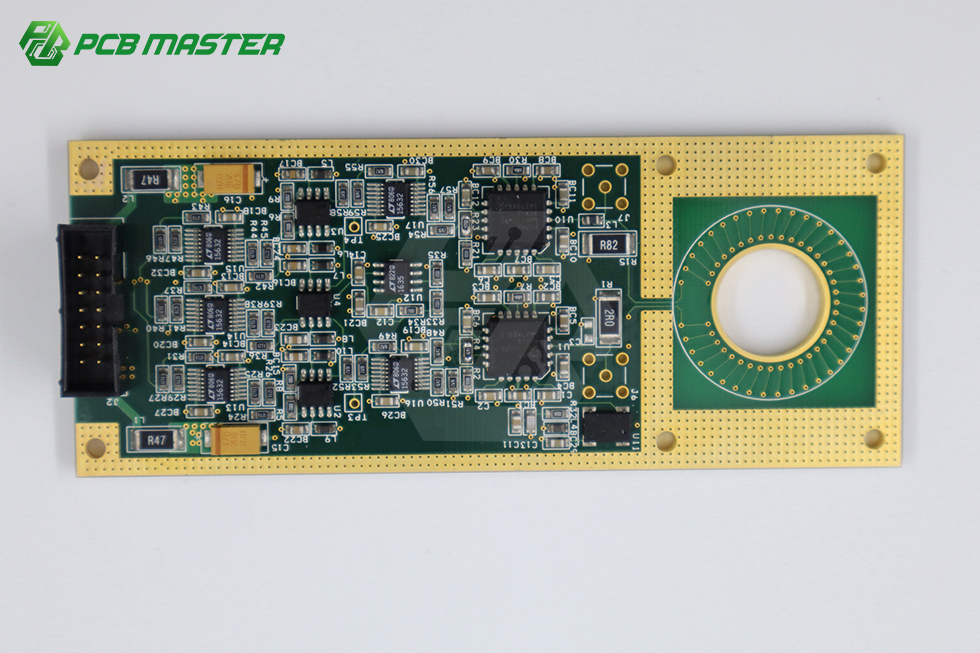
PCB material selection is the first decision point in a turnkey PCB manufacturing project.
Why a PCB Material and Certification Check Matters
PCBs are not interchangeable. A board that works for a consumer smart-home module can fail in a 5G base station, an automotive ECU, or an implantable medical device. The substrate determines signal integrity, thermal performance, mechanical flexibility, and long-term reliability under real operating conditions.
Certifications, on the other hand, determine whether the PCB can be legally sold and used in a target market. RoHS compliance is required for EU market entry, while UL safety certification is typically required for US market acceptance. Automotive programs usually require IATF 16949 manufacturing systems, and most electronics buyers expect ISO 9001 quality management coverage.
For engineering and procurement teams moving from the research phase into supplier evaluation, verifying both the material menu and the certification scope before quoting is not paperwork. It is a risk control step that directly affects lead time, cost, and end-product reliability.
PCB Material Options: Matching Substrate to Application
A capable PCB manufacturer should be able to match the substrate to the application rather than forcing a one-material design. The material options include:
- FR-4 — The standard material for general-purpose PCBs across consumer electronics, industrial controls, and most conventional devices. PCBMASTER offers FR-4 in TG155 and TG180 variants for improved thermal performance.
- Rogers / PTFE — Used for high-frequency PCBs where low dielectric loss and stable impedance are critical, such as 5G antennas, RF modules, and radar systems.
- Polyimide (PI) — The base material for flexible PCBs (FPC) and rigid-flex boards that must withstand repeated bending and tight-space integration.
- Ceramics (AlN, Al₂O₃) — Used for thermal management applications, especially where high thermal conductivity and electrical insulation are required for power and LED modules.
- Metal-core (Aluminum / Copper / Iron / Steel) — Used in metal-core and heavy copper PCBs for high-current power electronics, automotive, and industrial power applications because the metal base spreads heat and carries higher current.
What each option means for a buyer:
- FR-4 with higher Tg (TG155, TG180) adds thermal margin for lead-free assembly and higher operating temperatures without switching to expensive specialty laminates.
- Rogers/PTFE materials require controlled lamination processes and impedance testing. If your design requires them, the manufacturer should demonstrate an established high-frequency PCB production line, not a one-off capability.
- Polyimide is essential for flex and rigid-flex. Verify layer-count support and the manufacturer's ability to control bend radius and dynamic flexing reliability.
- Ceramic substrates (AlN, Al₂O₃) solve thermal problems but require different handling, drilling, and plating processes than FR-4. Check whether the manufacturer treats them as a standard process.
- Metal-core and heavy copper boards address high current and heat dissipation. Confirm maximum copper weight and plating aspect ratio before finalizing the design.
PCBMASTER's Material and Process Capabilities
PCBMASTER positions its product line as a one-stop PCB manufacturing and assembly service covering standard, advanced, and specialty substrates. The company's stated material support includes:
- FR-4 TG180 and FR-4 TG155
- Rogers and PTFE for high-frequency and high-speed boards
- Ceramics (AlN, Al₂O₃) for thermal management
- Polyimide (PI) for FPC and rigid-flex PCB projects
- Metal-core (Al / Cu / Fe / Steel) for heavy copper applications
- BT and other IC substrate materials
For layer counts, the company supports up to 64-layer boards, Any-Layer HDI up to 12 layers, and a range of special processes including POFV, N+N structures, hybrid lamination, deep blind microvia, and metallized half holes. Maximum finished dimensions are 620 × 1092 mm, with a maximum finished board thickness of 4.2 mm.
These figures matter for engineers evaluating whether a potential supplier can handle a board with deep blind microvias, high-layer registration requirements, or mixed-material stack-ups. For a buyer, the capability statement means one fewer qualification risk if the eventual design moves beyond a conventional FR-4 board.
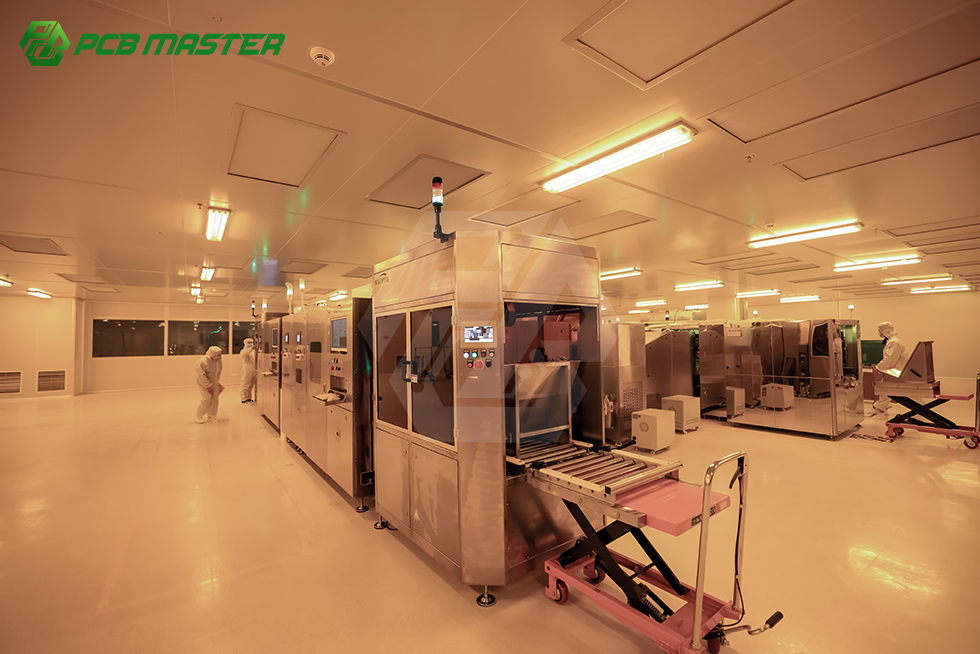
Automatic laser direct imaging (LDI) supports fine-line patterns and layer registration required for multilayer HDI PCBs.
Certifications to Verify: ISO, IATF, UL, and RoHS
Certifications provide a verifiable baseline for assessing a PCB manufacturer. They are not marketing slogans; they are documented quality and compliance systems. For a turnkey PCB assembly project that will be sold into a regulated market, each certification covers a different part of the risk profile.
ISO 9001: Quality Management System
ISO 9001 (International Quality Management System) is the foundational quality certification for PCB manufacturing and assembly. PCBMASTER states that its PCB products are manufactured under a quality management system certified to ISO 9001, with quality coverage across manufacturing and assembly processes—from incoming material inspection to finished-goods shipment—for global electronics manufacturing markets.
In practice, an ISO 9001-certified facility should have documented procedures for incoming inspection, process control, corrective actions, and traceability. For buyers, it is the starting point for quality assurance. It does not guarantee automotive-grade or medical-grade performance on its own, but its absence is a significant red flag.
IATF 16949: Automotive Quality Management
IATF 16949 is the automotive quality management system standard. PCBMASTER states that its PCB product is covered by IATF 16949 certification, applicable to flex PCB, rigid-flex PCB, PCB manufacturing, and PCB assembly (PCBA) projects for global electronics manufacturing markets.
If your target program is an automotive ECU, a battery management system, a charging module, or any ADAS-related control board, IATF 16949 is typically requested by Tier-1 suppliers. It adds requirements beyond ISO 9001, including product safety, traceability, PPAP support, and failure-mode analysis. Buyers should confirm not only that the certification exists but that it applies to the specific production site and product family.
UL Safety Certification
UL Safety Certification applies to PCB materials and finished boards that must meet flammability and electrical safety requirements, principally for the US market. PCBMASTER states that its Flex PCB product is certified to UL safety requirements for the US market.
For PCB buyers, UL certification is usually tied to the laminate system and solder mask. If your product targets consumer electronics, industrial equipment, or networking hardware sold in North America, confirm that the board carries a recognized UL marking or that the manufacturer can provide traceability to the certified material system. The typical file is a UL yellow card or a certified material list.
RoHS: EU Green Environmental Compliance
RoHS (EU Green Environmental Compliance) restricts hazardous substances in electrical and electronic equipment sold into the EU. PCBMASTER states that its Flex PCB product is RoHS-certified for the EU market. Buyers exporting to Germany, the Netherlands, France, or anywhere in the European Economic Area should verify RoHS compliance at the raw-material and assembly-process level.
RoHS falls under the EU’s CE marking framework, meaning non-compliant boards can block the sale of the final product. For medical devices, industrial controls, consumer electronics, or telecommunications equipment intended for the EU, RoHS certification is a mandatory gate, not an optional bonus.
| Certification | Market / Standard | What It Covers | Why a Buyer Should Verify It |
|---|---|---|---|
| ISO 9001 | Global | Quality management system for manufacturing and assembly | Baseline evidence of documented process control and traceability |
| IATF 16949 | Automotive | Automotive quality management, product safety, PPAP-related readiness | Often mandatory for automotive Tier-1 programs and high-reliability supply chains |
| UL Safety Certification | US | Flammability and electrical safety of PCB materials and finished boards | Required or strongly preferred for products sold in North America |
| RoHS | EU | Restriction of hazardous substances in electrical/electronic products | Legal gate for placing products on the EU market |
Manufacturing Constraints That Should Shape Your Design
A certification review is not complete without checking whether the manufacturer's process parameters align with your design. PCBMASTER publishes a set of production limits that are directly relevant to engineering teams:
- Layer count: up to 64 layers; Any-Layer HDI stack-up available up to 12 layers.
- Impedance tolerance: ±7% for differential impedance above 50 ohm; ±6% for single-ended 50 ohm impedance.
- Layer registration tolerance: ≥3 mil for boards ≤12 layers; ≥4 mil for boards over 12 layers; ≥4 mil for N+N stack-up structures.
- Pattern accuracy: ±5 mil for board dimensions over 500 mm.
- Laser blind hole spec: 65/165 μm.
- Plated filled hole dimple: maximum 10 μm.
- Through-hole plating aspect ratio: 16:1.
- Minimum back-drill diameter: 0.35 mm;
- Minimum stub length: 5 mil;
- Minimum distance from back-drill to copper: 5 mil.
Why these numbers matter: if your design calls for 18-layer boards, 0.1 mm blind vias, and controlled 100 ohm differential pairs, a supplier limited to 12 layers and ±10% impedance will fail your signal-integrity budget. Checking process limits before quoting avoids reengineering later.
Turnkey PCB Assembly and Component Sourcing as part of the Verification
Material and certification checks should also include the assembly side. A turnkey PCB assembly service integrates PCB fabrication, component sourcing, and board assembly under one contract. For evaluation-stage buyers, the question is not only “Can you make the bare board?” but also “Can you source the BOM and assemble it under a controlled quality system?”
PCBMASTER describes its service as a one-stop PCBA model: design support, component sourcing, quick-turn prototyping, and high-volume production. Its OEM contract manufacturing service completes circuit board fabrication and one-stop component sourcing based on client-provided Gerber files, PCBdoc, and BOM. This is relevant to buyers because it affects accountability, lead time, and supply-chain risk. With a full turnkey provider, a single responsible party manages both board quality and assembly quality.
The company reports six self-owned factories with flexible on-demand scheduling for small-batch prototypes and mass orders, a standard sample MOQ of 5 pieces, and quick-turn prototype shipment within 24 hours for qualifying orders. Mass-production lead time depends on layer count, special processes, and component procurement cycles.
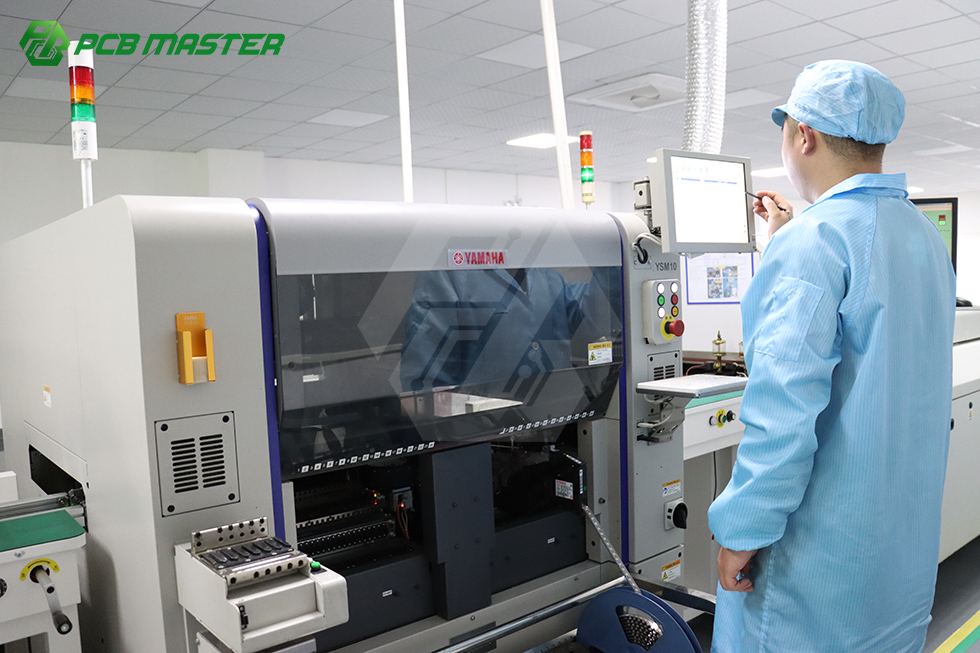
High-speed SMT placement supports prototype-to-volume turnkey PCB assembly.
Quality Control Measures to Look For
A written quality policy means little if the production line does not have corresponding inspection gates. In PCBMASTER’s case, the stated full-process quality control includes:
- Incoming material inspection
- In-process patrol inspection
- AOI (automated optical inspection)
- Automatic warpage and flatness testing
- Final finished board inspection
- Production committed to IPC Class 3 industrial specifications
For evaluation, ask any manufacturer to confirm these six points in writing: incoming inspection, first-article inspection, AOI coverage, electrical testing, final inspection, and IPC class commitment. These are the gates that catch solder defects, misalignment, shorts, opens, and laminate issues before boards are shipped.
Workflow: from Material Verification to Purchase Order
To make the evaluation process repeatable, use this checklist before you commit to a PCB prototype and assembly order:
- Define the target market. Identify whether the end product is sold in the EU, US, or automotive supply chains. This decides which certifications are mandatory: RoHS, UL, IATF 16949, or all of them.
- Lock the material set. Select FR-4, Rogers/PTFE, polyimide, ceramic, or metal-core based on electrical, thermal, mechanical, and cost requirements.
- Compare with factory capability. Check layer counts, impedance tolerances, hole sizes, aspect ratios, and special processes against your stack-up.
- Verify certification applicability. Confirm that the certifications apply to the actual product family and production site, not just to the corporate brochure.
- Evaluate turnkey sourcing. If your BOM contains long-lead or hard-to-source components, confirm the manufacturer's full turnkey component sourcing process.
- Review quality gates. Require the manufacturer to state IPC class, AOI coverage, electrical testing, and final inspection procedures in the quotation or quality agreement.
- Build prototype first. Start with 1–5 pieces for process validation before scaling to mass production.
Use-Case Scenarios: Where Material and Certification Verification Is Most Critical
Automotive Electronics
An automotive ECU or battery-management board must survive temperature cycling, vibration, and high-current loads. Buyers in this segment should require IATF 16949, high-Tg FR-4 or metal-core substrate capability, and controlled impedance for communication interfaces. Without IATF coverage, Tier-1 customers will typically reject the supplier during audit.
Medical Devices
Medical PCBA projects require high-reliability assembly, low-noise signal paths, and compliance with electrical safety expectations for diagnostic or monitoring equipment. Engineering teams should verify high-Tg material support, cleanroom or ESD-controlled assembly, tight impedance control, and documentation traceability. UL and RoHS are commonly required, while ISO 9001 is the baseline quality system for manufacturing and assembly.
5G and RF Modules
High-frequency PCBs depend on Rogers/PTFE materials and consistent dielectric properties. The manufacturer should demonstrate RF-capable lamination and impedance testing. Ask specifically about their impedance tolerance at high frequency and whether they can support hybrid laminates that combine Rogers and FR-4 in one stack-up.
AI Servers and Data Centers
AI server PCBs require high-layer-count boards, high-speed materials, and precise back-drilling to remove signal reflections. PCBMASTER’s 64-layer capability, 16:1 plating aspect ratio, and back-drill parameters are directly relevant for this segment. Buyers should verify that the supplier can handle the full stack-up and that the assembly line is equipped for high-density BGAs and connectors.

Automated visual inspection provides a final physical quality gate before PCB shipment.
Why Buyers Should Ask for a Capability Profile Before Ordering
More than 3,000 valid orders are processed daily at PCBMASTER, with 1–5-piece prototype support and large-batch mass production across an 80,000 m² self-owned manufacturing base. The company reports an annual output of 1.2 billion pieces, a 100-member R&D engineering team, and a first-pass production yield of 99.6%, with an on-time delivery rate of 99.5%. It exports primarily to Europe and North America.
These numbers are relevant to evaluation because they indicate the manufacturer operates at scale, processes high daily order volume, and maintains documented quality/reliability metrics. For any supplier claim of this kind, ask for supporting records within your quality audit rather than treating published figures as guarantees.
FAQ
What certifications should a PCB manufacturer hold for global electronics markets?
For global electronics manufacturing, the baseline expectations are ISO 9001 for quality management and RoHS for EU environmental compliance. If the product will be sold in the US, verify UL safety certification. For automotive programs, IATF 16949 is typically required. PCBMASTER states that its PCB products are covered by ISO 9001 and IATF 16949, that its Flex PCB product is RoHS-certified for the EU market, and that UL safety certification applies for the US market.
Which PCB materials are available for high-frequency or thermally demanding applications?
Material options for PCBs include FR-4 for standard applications, Rogers/PTFE for high-frequency PCBs, polyimide for flexible PCBs, ceramics (AlN, Al₂O₃) for thermal management, and metal-core (Al/Cu/Fe/Steel) for heavy copper needs. PCBMASTER supports these material categories within its one-stop PCB manufacturing and assembly service.
What is full turnkey component sourcing in PCB assembly?
Full turnkey component sourcing means the PCB manufacturer is responsible for procuring all BOM components, performing incoming inspection, and assembling the board under one contract, so the buyer works with a single accountable party. In PCBMASTER’s OEM model, the company completes circuit board fabrication and component sourcing based on client-provided Gerber files, PCBdoc, and BOM.
Can I order a small batch of PCB prototypes before mass production?
Yes. Standard sample MOQ at PCBMASTER is 5 pieces, and quick-turn prototype service can be shipped within 24 hours for qualifying orders. Mass-production MOQ varies according to board structure and special processes and is confirmed through separate consultation for each project.
How long does mass production take at PCBMASTER?
Mass production lead time varies by layer count, special processes, and component procurement cycle at PCBMASTER, and is confirmed per official order. Prototype lead time can be as fast as 24 hours for quick-turn orders, while production schedules depend on the specific stack-up, material availability, and sourcing complexity.
Conclusion
A PCB prototype and assembly project is only as strong as the material and certification foundation beneath it. FR-4, Rogers/PTFE, polyimide, ceramics, and metal-core substrates each solve a different class of engineering problem, and certifications such as ISO 9001, IATF 16949, UL, and RoHS provide the compliance evidence that determines where a finished product can be sold.
Before you commit to a full turnkey run, verify four things: the material set against your design requirements, the certification scope against your target market, the process parameters against your stack-up, and the quality gates against your reliability target. PCBMASTER’s published capabilities provide a practical reference: up to 64 layers, Any-Layer HDI, high-frequency and ceramic material support, ISO 9001 and IATF 16949 coverage, UL and RoHS certification, plus turnkey assembly with full component sourcing. To move from verification to the next engineering decision, request the detailed capability profile and discuss your stack-up with the PCBMASTER team.
Ready to verify your PCB stack-up against certified manufacturing capability?
Have Questions or Need More Details?
Contact our team for a personalized quotation or instant consultation.
Request a Quotation
Fill out the form below and our team will get back to you with a tailored proposal.
WhatsApp Direct Chat
Prefer to chat in real-time? Message us on WhatsApp for instant assistance & quick answers.
- Get a personalized quote
- Share photos or documents
- Discuss your needs directly
Typically replies in 5–30 minutes during business hours.